Ultra-processed food has become one of the most discussed topics in nutrition, yet it remains one of the most misunderstood. What actually counts as "ultra-processed"? Is your whole-grain bread a UPF? What about those "healthy" protein bars? The confusion often stems from the fact that nearly all food is processed in some way, making it hard to draw a line between a bag of frozen peas and a bag of neon-orange snacks.
This guide provides a practical method for identifying ultra-processed products at the store. Instead of relying on social media panic, we’ll use the NOVA classification system to understand what’s inside the package—and more importantly, what’s hidden behind the marketing.
What Makes Food "Ultra-Processed"?
The term "ultra-processed food" (UPF) comes from the NOVA classification system, which groups food based on the extent and purpose of industrial processing. While traditional processing (like freezing or canning) is often done to preserve food, ultra-processing is done to create shelf-stable, hyper-palatable products from substances derived from foods and additives.
The key distinction is the presence of ingredients you wouldn't find in a home kitchen: emulsifiers, humectants, flavor enhancers, and bulking agents. These industrial "cosmetic" additives are used to mimic the texture and taste of real food while significantly extending shelf life. If the ingredient list looks more like a chemistry lab inventory than a pantry list, you’re looking at a UPF.
The NOVA System: 4 Groups in 30 Seconds
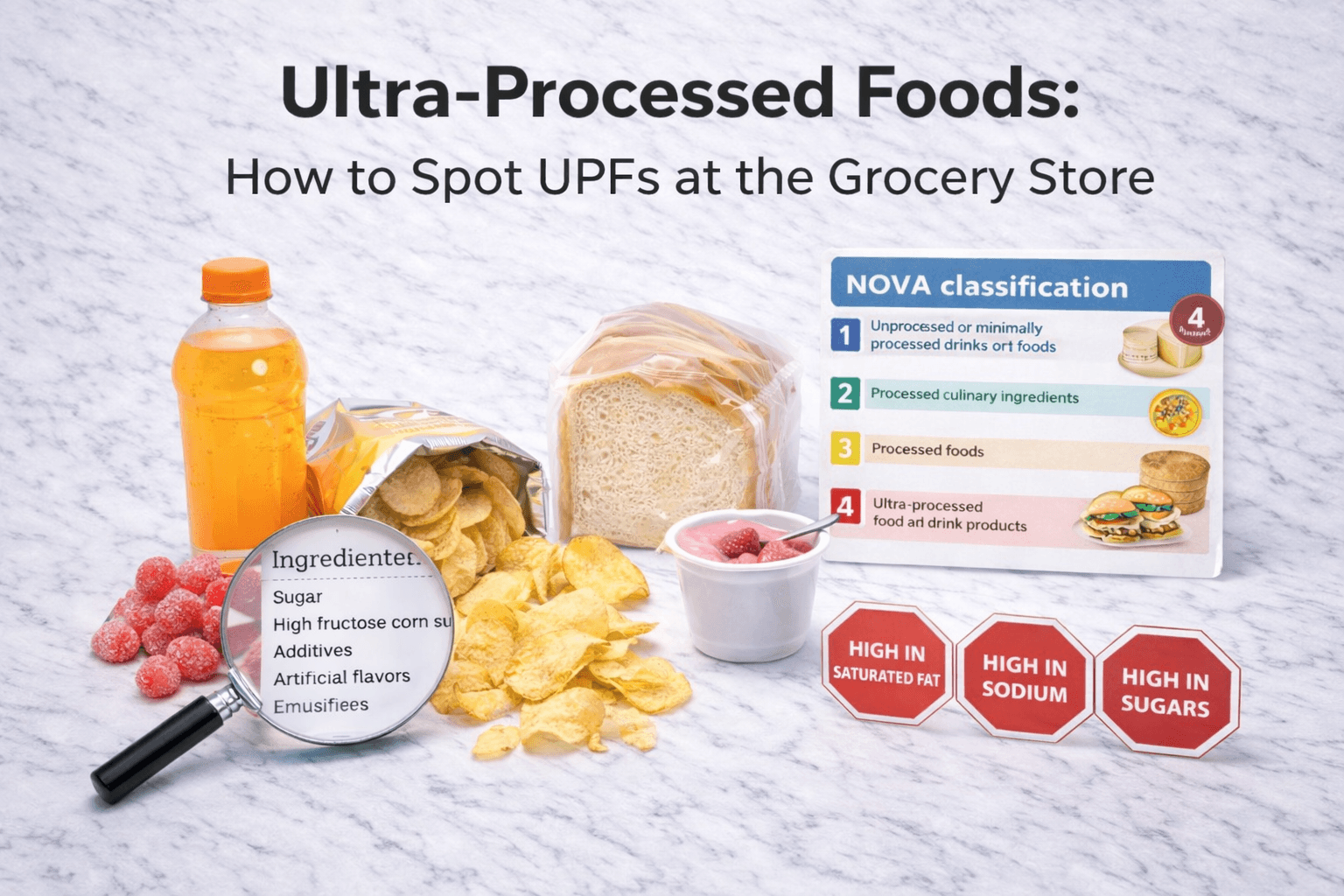
To understand UPFs, you first need to understand the four NOVA categories. Group 1 includes unprocessed or minimally processed foods like fresh fruit, eggs, and plain milk. Group 2 consists of processed culinary ingredients like olive oil, butter, and salt. Group 3 are "processed foods"—simple combinations of Group 1 and 2, such as canned tomatoes or freshly baked bread.
Group 4 is where Ultra-Processed Foods live. These are industrial formulations that typically contain five or more ingredients, including substances not used in home cooking. The boundary between Group 3 and Group 4 is often where shoppers get stuck. For example, a loaf of bread made from flour, water, yeast, and salt is Group 3. A packaged bread with 20 ingredients, including dough conditioners and preservatives, is Group 4.
The UPF Ingredient Checklist: What to Look For
When scanning a label, certain ingredient types are immediate signals that a product is ultra-processed. High-fructose corn syrup, maltodextrin, and hydrogenated oils are classic UPF markers. You should also watch for protein isolates (like soy or whey isolate) and a wide range of emulsifiers or thickeners like soy lecithin, carrageenan, and xanthan gum.
Flavor enhancers such as MSG, artificial flavors, and various cosmetic dyes (like Red 40 or Caramel Color) also strongly suggest NOVA Group 4 status. Finally, the presence of industrial preservatives like BHA, BHT, and potassium sorbate confirms that the product has undergone significant industrial manipulation to ensure it can stay on a shelf for months or years.
10 "Healthy-Looking" Products That Are Actually UPF
Marketing often creates a "health halo" around products that are technically ultra-processed. Many granola bars, for instance, are held together by glucose syrup and rice crisps bulked with maltodextrin. Flavored yogurts often contain modified starch and artificial sweeteners rather than just fruit and dairy. Even "multigrain" bread can be a UPF if it includes mono-diglycerides and dough conditioners.
Veggie chips, plant-based meat alternatives, and protein shakes are other common examples. These products are often marketed as "clean" or "natural," but their ingredient lists reveal a complex industrial assembly. The point isn't that these foods are "poison," but rather that their marketing often masks the high degree of processing they’ve undergone.
Processed vs. Ultra-Processed: Not All Processing Is Bad
It’s important to remember that processing is a spectrum, not a binary choice. Without processing, we wouldn’t have pasteurized milk, canned beans, or frozen vegetables—all of which are nutritious and convenient. These are NOVA Group 1 or 3 foods because the processing serves a clear purpose: making whole foods safe and accessible.
Ultra-processing is different because it breaks food down into its constituent parts (fats, starches, sugars, proteins) and then reassembles them with industrial additives. A canned tomato is processed to stay fresh; a frozen pepperoni pizza is ultra-processed to be a hyper-palatable meal-in-a-box. Learning this distinction allows you to embrace helpful processing while being mindful of the industrial formulations.
Canada's 2026 Front-of-Pack Labels and UPF
Beginning in 2026, Health Canada will require a front-of-package "high in" symbol for products that exceed specific thresholds for saturated fat, sugars, or sodium. While this isn't an explicit UPF label, there is a massive overlap. Most ultra-processed foods are engineered to be high in at least one of these three nutrients to improve taste and shelf life.
This new symbol will serve as an immediate warning sign. If you see the "high in" symbol, it's a good trigger to flip the package over and check the ingredient list for the UPF markers we’ve discussed. By combining the quick signal from the front with a 30-second scan of the back, you can take full control of what goes into your shopping cart.
A Practical Approach: Reduce, Don't Obsess
The goal isn't to reach "zero UPF" or to feel guilty about every convenience food. Instead, aim for awareness. Start by checking the products you buy most often—your "top 10" repeat purchases. If your favorite bread or yogurt is an industrial formulation, try searching for a simpler alternative with an ingredient list you can actually recognize.
Use the "home kitchen test": if you can't imagine buying the ingredients and using them in your own kitchen, it's probably a UPF. By shifting your default choices toward minimally processed foods, you can significantly reduce your UPF intake without the stress of perfectionism. Remember, the power is in knowing what’s actually in the package.
Frequently Asked Questions
What are ultra-processed foods?
Ultra-processed foods are industrial formulations made from substances derived from foods and additives. They contain ingredients not typically used in home kitchens, such as emulsifiers, flavor enhancers, and hydrogenated oils.
Are all processed foods unhealthy?
No. Processing includes washing, freezing, and canning. Foods like frozen vegetables, canned beans, and plain yogurt are minimally processed and can be part of a healthy diet. The concern is specifically with "ultra-processed" foods that rely on industrial chemicals.
How do I know if a product is ultra-processed?
Check the ingredient list. If it's long (usually 10+ items) and contains unidentified names like maltodextrin, mono-diglycerides, or various artificial colors and preservatives, it is likely ultra-processed.
What is the NOVA food classification?
NOVA is a system that categorizes food into four groups based on processing. Group 1 is minimally processed, Group 2 is culinary ingredients, Group 3 is processed (simple combinations), and Group 4 is ultra-processed.
Does Canada label ultra-processed foods?
Not directly, but a new law starting in 2026 will require a "high in" symbol for products high in salt, sugar, or saturated fat. This will flag many ultra-processed products for consumers.