How to Read a Food Label in 60 Seconds: A Parent's Visual Guide
You're standing in the cereal aisle. Your toddler is doing that thing where they suddenly need to be held right now, and you're trying to figure out if this box of "wholesome" granola bars is actually just candy in disguise. The label looks like a spreadsheet had a baby with a chemistry textbook. Numbers everywhere. Words you can't pronounce. And you've got maybe 60 seconds before someone has a meltdown.
Here's the thing nobody tells you: you don't need to decode every single line on that label. You just need to know where to look. This guide gives you a dead-simple, five-check method that works on any packaged food. Whether you're dodging allergens, checking for halal compliance, or just trying to keep sugar bombs out of your cart, this is the shortcut you've been looking for.
Why Most People Read Labels Wrong
If you've ever felt paralyzed staring at a Nutrition Facts panel, you're not alone. Those panels can contain 20+ data points — and trying to process all of them while your kid asks for cookies is a recipe for decision fatigue. Most people either give up entirely or fall back on whatever the front of the package claims. "Natural"? "Wholesome"? Those words are basically meaningless, but they feel reassuring when you're overwhelmed.
The FDA designed the Nutrition Facts label to help people compare products and track nutrients. But here's what they didn't design it for: answering questions like "Will this send my kid to the ER because of their nut allergy?" or "Is this actually halal?" Those answers require looking at different parts of the package entirely — and most parents don't know where to start.
The method below fixes that. Five checks. About 10-15 seconds each. Let's go.
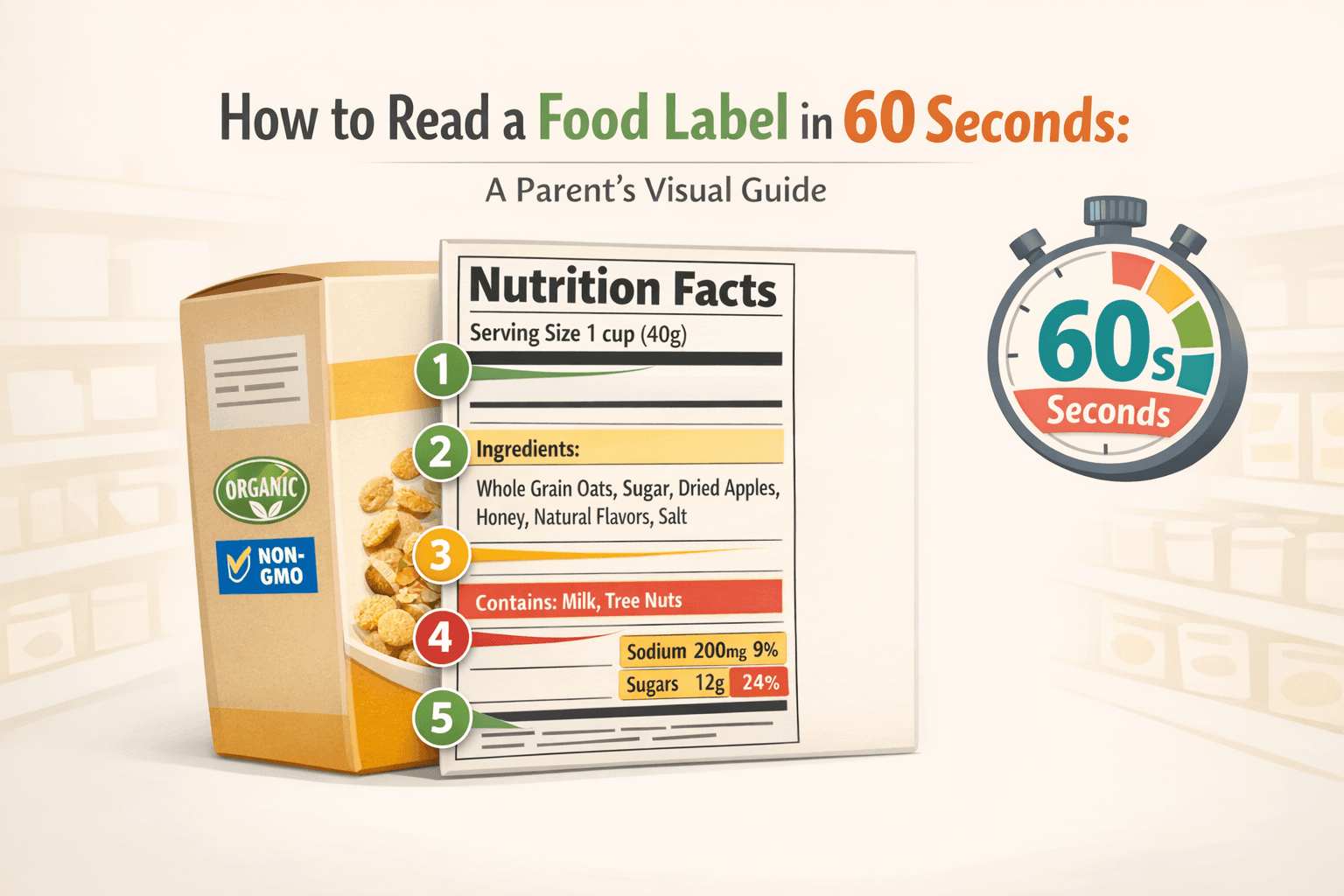
The 5-Check Method: What to Look at First
Think of this as a top-to-bottom scan. With practice, you'll do all five without even thinking about it.
Check 1 — Serving Size and Servings Per Container
Start at the very top of the Nutrition Facts panel. That serving size? It's the foundation everything else is built on — and it's where most people mess up.
Picture this: a bag of chips lists 150 calories per serving. Sounds reasonable. But the bag contains 3 servings. Eat the whole thing (and let's be honest, who eats 1/3 of a chip bag?) and you're at 450 calories. Same math applies to sugar, sodium, everything.
What to do: Glance at the serving size and be honest with yourself. Is that how much you'd actually eat? If you'd crush the whole container in one sitting, multiply accordingly.
Since 2016, the FDA has required serving sizes to reflect what people actually eat, not some fantasy portion. But "typical" is still an average — your portion might be bigger.
Check 2 — The Ingredient List (First Five Rule)
Find the ingredient list (usually below or beside the Nutrition Facts). Here's the key: ingredients are listed by weight, from most to least. The first ingredient is what this product mostly is.
The First Five Rule: Those first five ingredients tell you what you're really buying. If sugar (or its sneaky cousins like glucose-fructose, dextrose, maltodextrin, or cane syrup) shows up in that top five, sugar is a major ingredient — no matter what the front of the package claims about being "wholesome."
What to do: Read the first five. Recognize them as real food? Good sign. See refined flours, sugars, or industrial oils dominating the list? That's your red flag.
Check 3 — The "Contains" Allergen Statement
If food allergies are part of your family's reality, this check is non-negotiable. In the US, the Food Allergen Labeling and Consumer Protection Act (FALCPA) mandates that nine major allergens be clearly declared: milk, eggs, fish, shellfish, tree nuts, peanuts, wheat, soy, and sesame (that last one was added in 2023 under the FASTER Act).
Most manufacturers put a bold "Contains:" statement right after the ingredient list — something like Contains: milk, wheat, soy.
What to do: Check that "Contains" line every single time, even for products you've bought before. Formulations change. What's safe last month might not be safe today.
The catch: Those "may contain" or "processed in a facility that also handles..." statements? Totally voluntary. Their absence doesn't mean the product is allergen-free — just that the manufacturer chose not to warn you about cross-contact. And allergens hide behind unfamiliar names: casein is milk, albumin is egg, tahini is sesame. A dedicated allergen detection tool can catch what your eyes might miss.
Check 4 — % Daily Value Red Flags (Sugar, Sodium, Saturated Fat)
Look at the right side of the Nutrition Facts panel for the % Daily Value (%DV) column. This tells you how much of your daily recommended intake one serving represents, based on a 2,000-calorie diet.
The 5% / 20% Rule (straight from the FDA):
5% DV or less = low in that nutrient
20% DV or more = high in that nutrient
For the stuff you want to limit — saturated fat, sodium, and added sugars — aim for under 20% DV per serving. For nutrients you want more of (fiber, vitamin D, calcium, iron, potassium), look for over 20% DV.
What to do: Scan three specific rows: Saturated Fat, Sodium, and Added Sugars. If any hit 20% DV or higher, that's your warning.
For Canadian parents: As of January 1, 2026, Health Canada requires a front-of-package "high in" symbol — a black-and-white magnifying glass icon — on products exceeding thresholds for saturated fat, sugars, or sodium. If you see that symbol, the decision's already been made for you.
Check 5 — Certification Logos and Claims
The front of the package is where certifications live — but not all claims carry the same weight.
Table
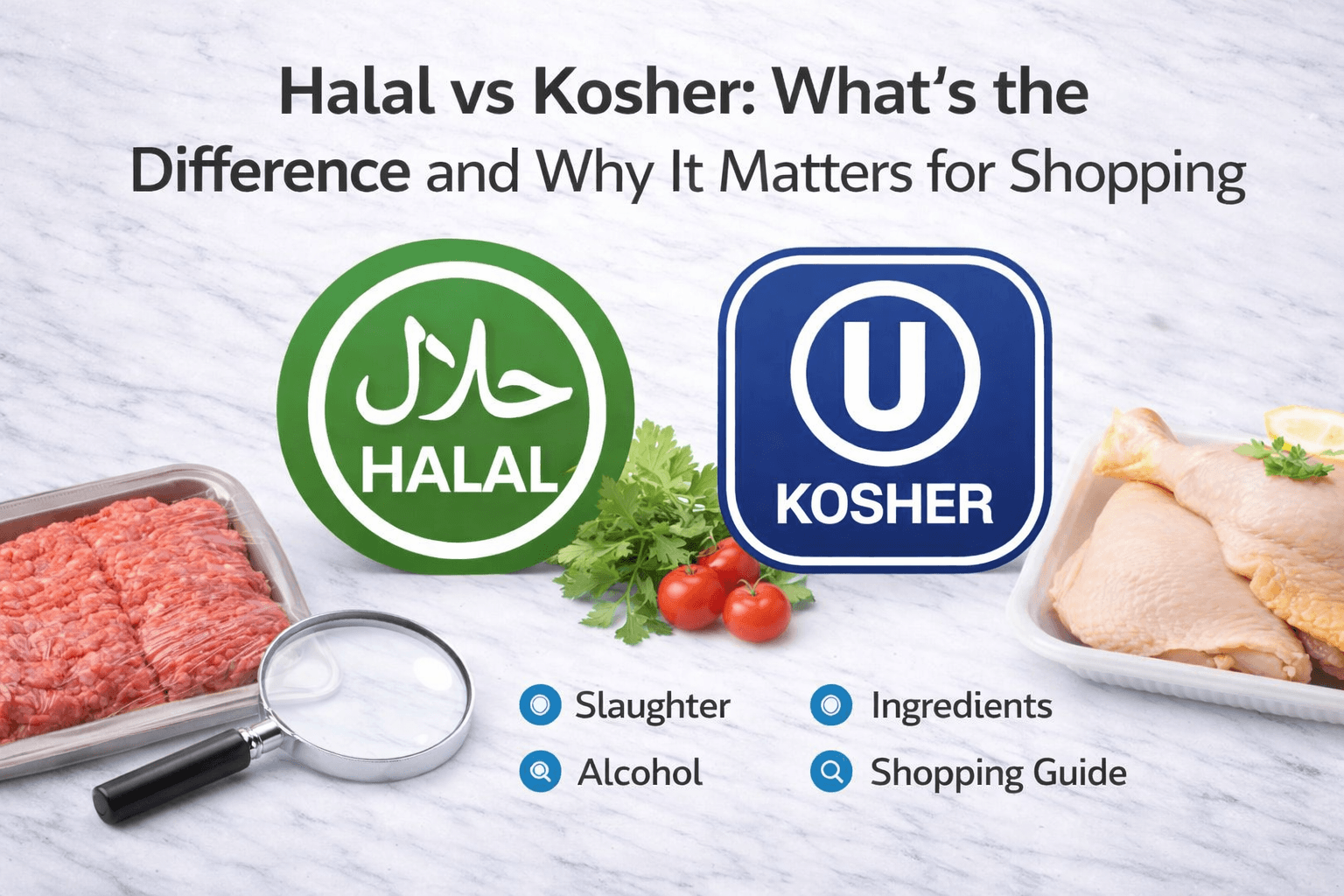
Logo / ClaimWhat it actually meansWhat it doesn't meanUSDA OrganicNo synthetic pesticides, GMOs, or artificial fertilizersNot necessarily healthier, lower in sugar, or allergen-freeNon-GMO Project VerifiedIngredients tested to avoid GMO inputsNot organic; doesn't cover pesticides or safetyHalal Certified (named certifier)A recognized body verified complianceMany halal products don't carry this; some are halal without formal certificationGluten-FreeMeets FDA threshold of less than 20 ppm glutenCross-contact still possible depending on manufacturing"Natural"Almost nothing — the FDA has no formal definitionNot organic, not non-GMO, not additive-free
What to do: Look for named certifiers, not vague claims. "Halal" printed by the manufacturer without a certifying body is weaker than a recognized halal certification logo. "Natural" with no certification backing it is just marketing fluff.
For deeper verification of halal status, GMO signals, or safety flags, tools like Nutika's halal detection and GMO detection can provide confidence scoring based on the actual ingredient list.
Canada's New Front-of-Pack Warning Labels (2026)
Starting January 1, 2026, most prepackaged foods sold in Canada must display a front-of-package nutrition symbol if they exceed Health Canada's thresholds for saturated fat, sugars, or sodium. The symbol is a standardized black-and-white magnifying glass with "High in" followed by the relevant nutrient(s).
This applies to domestic and imported products alike. Some exemptions exist — plain milk, fresh fruits and vegetables, and certain single-ingredient foods don't need the symbol.
What this means for you: That FOP symbol does the work of Check 4 before you even flip the package. See the symbol? The product exceeds a threshold. Don't see it? Either it's below the thresholds or it's exempt.
Source: Government of Canada, Canadian Food Inspection Agency— Front-of-package nutrition symbol.
The "Natural Flavors" Trap and Other Misleading Terms
Some terms on ingredient lists sound transparent but actually obscure what's really in there:
Natural flavors: Under FDA rules, this catch-all term covers any flavoring from plant or animal sources — fruits, vegetables, meat, dairy, fermentation products. The specific source doesn't have to be disclosed, which matters for allergens and halal compliance.
Spices: Like natural flavors, "spices" is a permitted grouping. Individual spices don't need listing unless they're also allergens.
Modified starch / modified milk ingredients: "Modified" refers to processing (enzymatic or chemical treatment), not genetic modification. These terms don't indicate GMO status.
Color added: Doesn't specify which colorant. This is where dyes like Red 40 or Yellow 5 can hide without being individually named in some product categories.
The bottom line: When you see vague grouping terms, the label is following regulations — but it's also where a scanning tool adds real value. Nutika's Toxicology Radar flags known safety-signal ingredients even when they're buried in grouped terms.
When 60 Seconds Isn't Enough: How a Scanner App Helps
The 5-Check Method handles most grocery decisions. But some questions need more than a quick visual scan:
Is this ingredient halal under my standard? Mono- and diglycerides can be plant or animal-derived — the label won't tell you which.
Does this contain a hidden allergen name I don't recognize? Dozens of alternative names for common allergens don't appear in the "Contains" statement.
Is this additive flagged by safety research? BHA, BHT, sodium nitrite — the label lists them, but doesn't explain why they matter.
This is where a food scanner app becomes essential. Nutika reads ingredient labels from a photo, then cross-references for safety signals, halal status, allergen risks, and GMO indicators — using FDA-based thresholds, not guesswork.
FAQ
What is the 5%/20% rule for food labels?
The FDA's guideline for using % Daily Value: 5% DV or less per serving means the product is low in that nutrient, and 20% DV or more means it's high. Use this to limit saturated fat, sodium, and added sugars, and to seek out fiber, vitamin D, calcium, iron, and potassium.
What are the 9 major allergens that must be listed on labels?
In the United States, FALCPA and the FASTER Act require disclosure of: milk, eggs, fish, shellfish, tree nuts, peanuts, wheat, soy, and sesame. Canada requires similar disclosure under its Food and Drug Regulations.
Do food labels show if a product is halal?
Only if the manufacturer or a certifying body has placed a halal logo or statement on the package. There is no regulatory requirement in Canada or the US to declare halal status. Many products are halal-compatible based on their ingredients but carry no indication on the label. A halal detection tool can help interpret ingredient lists against your chosen standard.
What does "natural flavors" mean on an ingredient list?
Under FDA regulations, natural flavors are flavoring substances derived from plant or animal sources — including fruits, vegetables, meat, dairy, and fermentation products. The specific source is not required to be disclosed, which can be a concern for allergen and halal considerations.
Are food labels different in Canada vs. the United States?
The core structure is similar, but there are differences. Canada now requires a front-of-package "high in" symbol (effective January 1, 2026) for products exceeding thresholds for saturated fat, sugars, or sodium. Canada also requires bilingual labeling (English and French). The Big 9 allergens are similar in both countries, though specific regulations and exemptions differ.