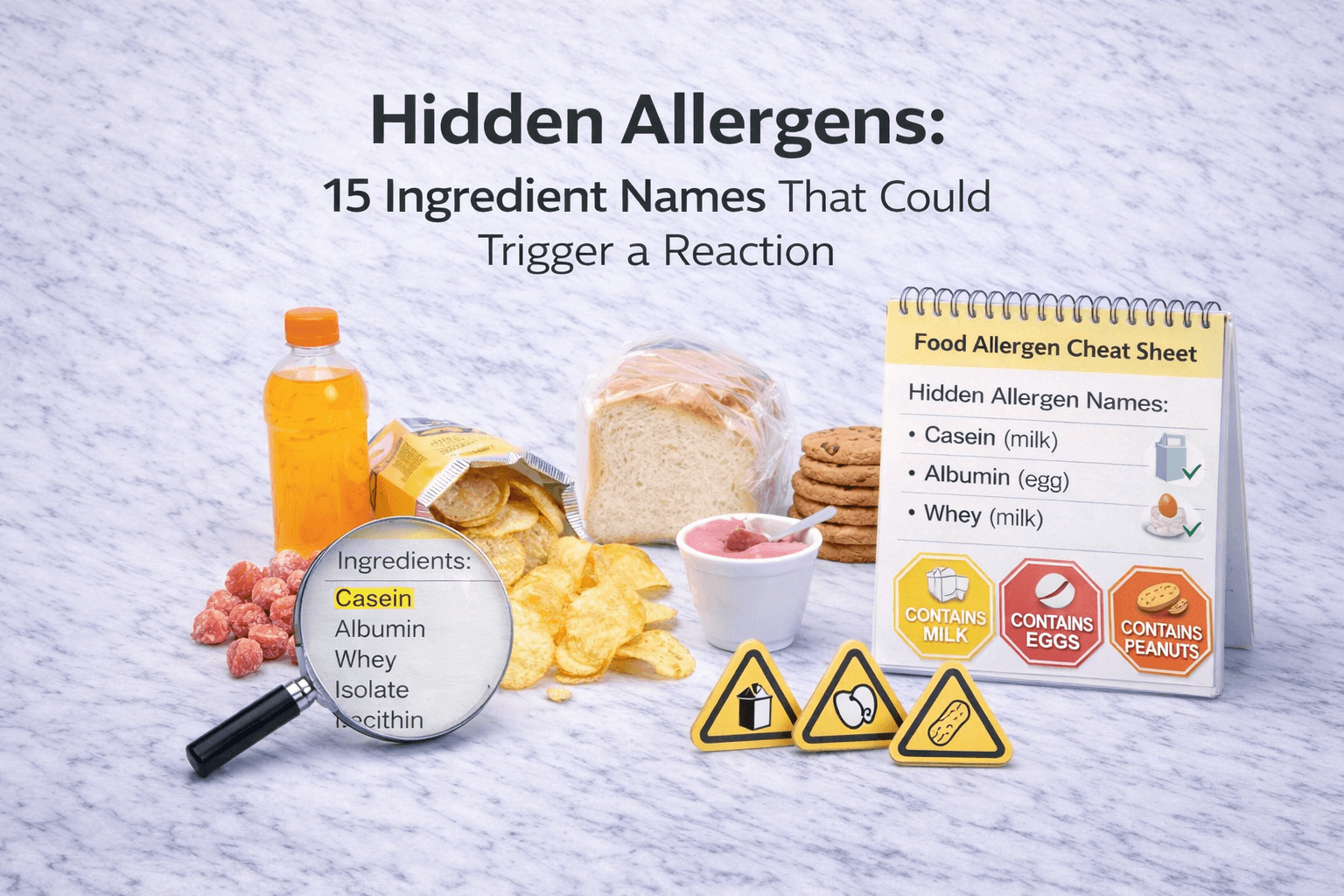
If your child has a food allergy, you already read every label. But reading isn't enough when allergens hide behind names you don't recognize. Casein is milk. Albumin is egg. Tahini is sesame. And none of those words look like what they are to the untrained eye.
This guide lists 15 of the most commonly hidden allergen names on food labels, explains where they typically appear, and covers the labeling gaps that can catch even the most careful parents off guard.
Why Allergens Hide on Labels
Food labeling laws, like the FASTER Act in the US, require manufacturers to declare major allergens. However, the law allows for flexibility in the disclosure format. An allergen can be listed in the ingredient list using its common name or with the source in parentheses (e.g., "casein (milk)"). Alternatively, it can be listed in a separate "Contains" statement after the ingredient list.
The problem arises when a manufacturer doesn't use the parenthetical format and the "Contains" statement is incomplete. Some highly processed derivatives might not be recognized by the manufacturer as requiring disclosure under their interpretation of the law. For parents, knowing the technical names is a critical safety net.
The Big 9 Allergens (Quick Reference)
In the US and Canada, the "Big 9" must be clearly declared on packaged food labels. These include Milk, Eggs, Fish, Shellfish, Tree Nuts, Peanuts, Wheat, Soy, and Sesame. Canada also adds mustard and sulphites to this list of priority allergens.
Understanding these nine categories is the baseline for allergy safety. If you see an ingredient that sounds scientific, it almost always originates from one of these nine groups.
15 Hidden Allergen Names Every Parent Should Recognize
The following ingredients are common derivatives of the Big 9 that often confuse shoppers. Casein and Sodium Caseinate are milk-derived and found in everything from non-dairy creamers to processed meats. Whey and Lactalbumin are also milk proteins common in protein bars and baked goods.
For egg allergies, watch for Albumin, Lysozyme, and Ovalbumin. Wheat can hide in Semolina, Spelt, and Kamut. Soy is often present as Lecithin or Textured Vegetable Protein (TVP). Sesame might be listed as Tahini or Halvah, while Fish can hide in imitation products like Surimi. Being able to spot these 15 names instantly can prevent a accidental exposure.
The "Contains" Statement vs. the Ingredient List
You should always check two places on a food package. The "Contains" statement is a quick summary line that is easy to screen. However, it is a summary—not a legal transcript. The ingredient list is the primary source of truth.
Sometimes, the "Contains" statement might miss a derivative that you know your child is sensitive to. By reading both the summary and the full ingredient list, you create a double-check system that dramatically reduces the risk of missing a hidden allergen.
What "May Contain" Really Means (and Doesn't)
Precautionary statements like "may contain traces of..." or "processed in a facility that also handles..." are voluntary. Because they are unregulated, their presence doesn't always mean an allergen is in the product, and their absence doesn't guarantee the product is safe.
These warnings are the manufacturer's way of disclosing a theoretical risk of cross-contact on shared equipment. If your child has a severe allergy, these statements should be treated as a real risk. However, you should also be aware that two different brands might handle the same risk level with different (or no) labels.
Cross-Contact vs. Cross-Contamination
It's helpful to understand the difference between these terms. Cross-contact occurs when an allergen protein physically transfers to another food. These proteins cannot be "cooked away." Cross-contamination, on the other hand, usually refers to bacteria or pathogens.
For allergy management, cross-contact is the relevant danger. Even trace amounts of an allergen protein on a shared conveyor belt can trigger a severe reaction in sensitive individuals. This is why "shared equipment" warnings exist and why they must be taken seriously.
When Labels Change Without Warning
Manufacturers reformulate their products constantly. They might change a supplier or move production to a different facility that handles new allergens. They are not required to notify consumers of these shifts.
The rule of thumb for allergy parents is to read the label every single time—even for a product you have safely used for years. Don't rely on memory. Ingredient lists are dynamic, and a recent change could be the difference between a safe meal and an emergency.
Frequently Asked Questions
What are hidden allergens in food?
Hidden allergens are ingredients derived from major allergens that appear under technical or scientific names, such as casein for milk or albumin for egg.
What are the 9 major allergens on food labels?
The "Big 9" are milk, eggs, fish, shellfish, tree nuts, peanuts, wheat, soy, and sesame (which was recently added as a major allergen).
Does "may contain" mean there's an allergen in the product?
Not necessarily. It is a voluntary warning about the risk of cross-contact on shared equipment. However, for severe allergies, it should be treated as a warning of potential presence.
What is casein on a food label?
Casein is a protein derived from milk. It is often found in processed foods like non-dairy creamers and protein bars, and must be avoided by those with milk allergies.
How can I check food labels for allergens quickly?
Always start with the "Contains" statement for a quick screen, then read the full ingredient list to ensure no hidden derivatives or technical names were missed.